
Tea Time: Violet Leaf Tea
"If a kiss could be seen I think it would look like a violet." —Lucy Maud Montgomery
From the publisher: I’m really excited about exploring wild (and homegrown cultivated) teas this year. In this one, second in a series, Daniel Murphy gives us an honest review of violet leaf tea. You can find more on violets on the website linked in this overview, including lore and the information that violet leaves are rich in Vitamin C!
—Sandra Knauf
Tea Time: Violet Leaf Tea
by Daniel Murphy
The genus Viola is large and widespread. Its flowers are easily recognizable and obviously popular. A significant number of Viola species, hybrids, and cultivars are commercially available and commonly planted in flower beds and container gardens. Certain species have even become weeds – vicious lawn invaders in some people’s opinion. Violets (or pansies in some cases) are also edible. Their leaves and/or flowers can be used in salads, drinks, and desserts. One way to use the leaves is to make tea, so that’s what I did.
I imagine you can make tea from any Viola species, but after some searching I found that two species frequently mentioned are Viola odorata and Viola sororia—two very similar looking plants, one from the Old World and the other from the New World.
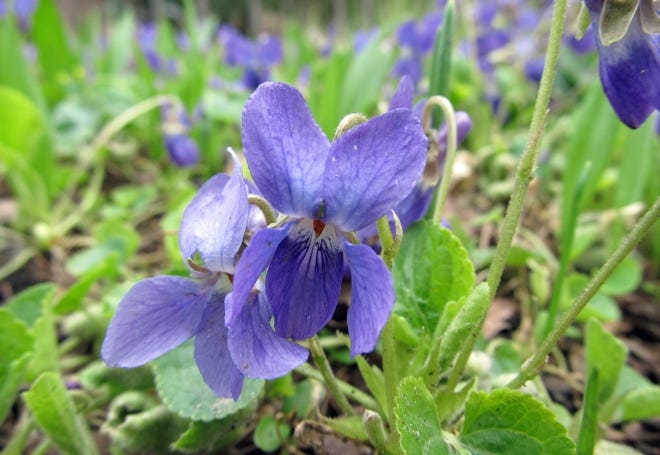
Viola odorata—commonly known as sweet violet, wood violet, or English violet—is distributed across Europe and into Asia and has been widely introduced outside of its natural range. It has round, oval, or heart-shaped leaves with toothed margins that grow from the base of the plant, giving it a groundcover-type habit. Its flowers range from dark purple to white and are borne atop a single stem that curves downward at the top like a shepherd’s crook. It has no leafy, upright stems, and it spreads horizontally via stolons and rhizomes. The flowers are distinctly fragrant and have a long history of being used in perfumes.
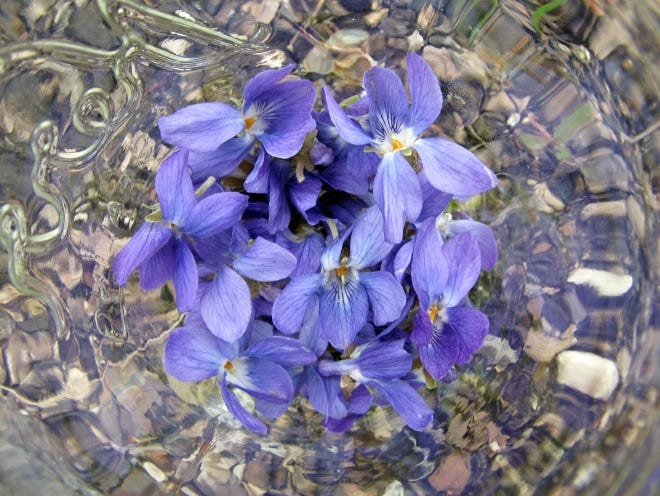
One way to get a good whiff of these flowers is to try a trick described in the book The Reason for Flowers by Stephen Buchmann:
Go into a garden or any natural area and select one or more flowers you want to investigate…. Select a small, thoroughly washed and dried glass jar with a tight-fitting lid. Place just one type of flower in the jar. Set your jar in a warm, sunny place such as a windowsill and come back in an hour or two. Carefully open the lid and sniff…. If you’ve selected a blossom with even the faintest scent, you should be able to smell it now, since the fragrance molecules have concentrated inside the jar.
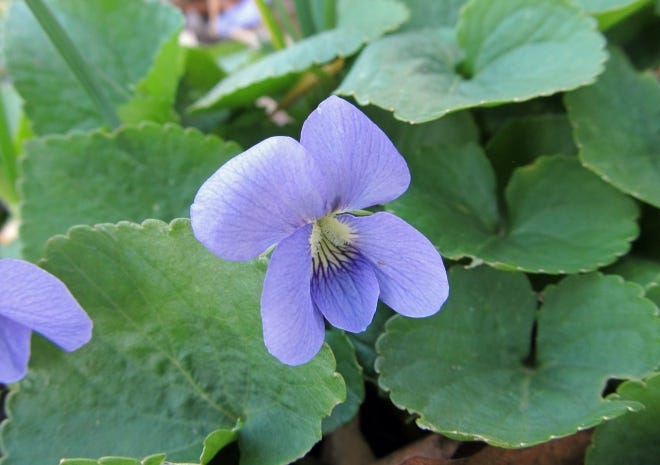
Viola sororia—native to eastern North America—is also commonly planted outside of its native range. It’s clearly a favorite, having earned the distinction of state flower in four U.S. states. Known as the common blue violet (or myriad other commons names), it looks and acts a lot like sweet violet. I distinguish them by their flowers, which are wider and rounder (chunkier, perhaps?) than sweet violet flowers, and their leaves, which are generally more heart-shaped. Feel free to correct me. If, like me, you’re having trouble identifying violets, keep in mind that Viola species are highly variable and notorious hybridizers, so don’t beat yourself up over it. It’s their “fault,” not yours.
Violets bloom when the air is cool and the days are short. They are among the earliest plants to flower after the new year and among the latest plants flowering as the year comes to a close. In his entry on violets in The Book of Forest and Thicket, John Eastman refers to these early bloomers as “this low, blue flame in the woods.” They are like “a pilot light that ignites the entire burst of resurrection we call spring.” I can’t really picture spring without them. I find their unique flowers so intriguing that I fixate on them whenever I see them. And once I learned that I could make a tea out of their leaves, I had to try it.
I used the leaves of Viola odorata (or what I, with my amateur skills, identified as V. odorata). I picked several of what looked to be young leaves and left them to dry in the sun for several days. Later, I chopped them up and brewed a tea according to the instructions found on this website (which also has lore and vitamin information). The recipe suggests using one tablespoon of dried leaves in sixteen ounces of water. Apparently, a little goes a long way, and I probably could have used fewer leaves than I did.
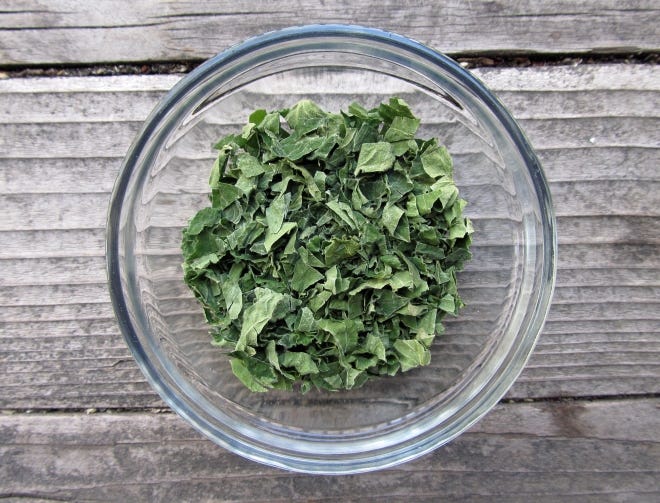
The tea has a nice green color and smells a bit like grass to me. It may even taste like grass. I found it fairly bitter. Sierra didn’t like it and called it musty. I enjoyed it, but would likely enjoy it more if I hadn’t made it quite so strong. The aforementioned website also recommends combining violet leaf with other things like mint, dandelion, clover, and/or chamomile. I imagine a combination of ingredients could be better than just violet leaf on its own. Another site warns that “some of the wild violets have an unpleasant soapy flavor,” so that’s something to keep in mind when selecting your leaves for tea and other things. Either way, violet leaf tea is an experience worth having.

Daniel Murphy is a weed lover and tree hugger that has been writing about plants for nearly twenty years—first as a very young man in his self-published zines, then in his blog, Awkward Botany: Amateur Botany for the Phystocurious (he also had a column for Greenwoman Magazine back in the "teens"). Daniel works as the Collections Curator at Idaho Botanical Garden where they have ecologically-savvy gardens such as the Lewis and Clark Native Plants Garden, Western Waterwise Garden, and the Firewise Garden. He has a MS in Biological Sciences and a BS in Horticulture and Crop Science. He lives in Boise and is married to the beautiful Sierra Laverty.
Speaking of tea, you can help support Daniel’s work at Ko-Fi. Financial support allows him a greater access to materials and experiences that lead to the heavily researched posts you’ve come to appreciate. Every dollar helps. If you’d rather not part with your money or simply don’t have any money to part with, you can always support by sharing posts with the folks you interact with. As always, thank you for reading and for helping us spread the plant love!
Sandra Knauf’s hilarious memoir about a lot of things wild and woolly, including raising chickens and hosting tea parties in the garden. Available on Amazon.
Love it. I decorated my Easter cake with violets growing in my back yard 💜